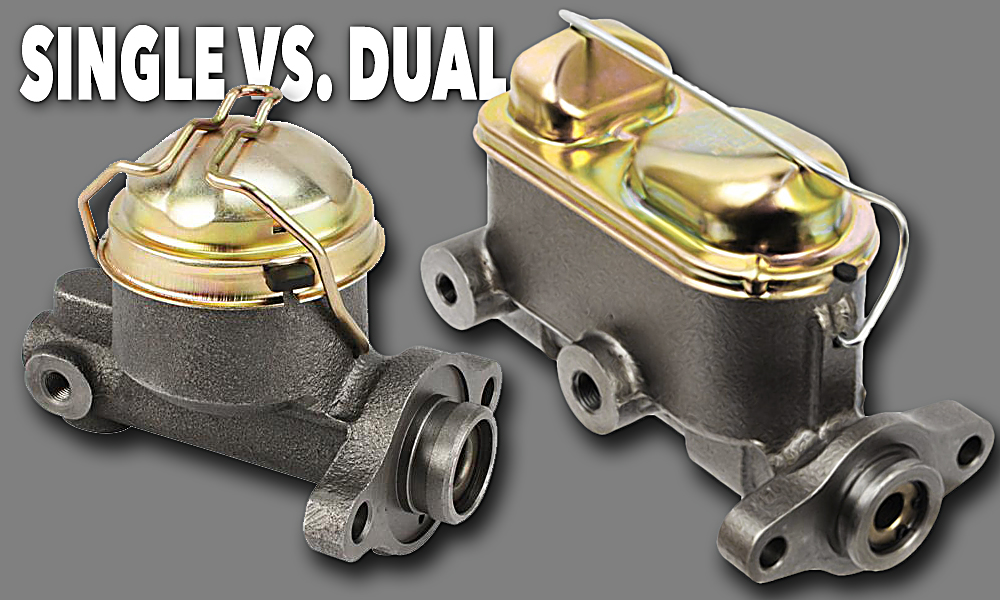
I have heard the argument many times, claiming a properly maintained single reservoir master cylinder is just as safe as a dual reservoir system. My response is always the same: “If a single reservoir system is so good, then why are they no longer offered?”
Often when things go wrong with a car mechanically, there is no warning they are about to fail, and most long-time enthusiasts have had their share of new or rebuilt parts fail as well. Brake systems are composed of numerous parts all working together to stop the vehicle. As cars evolved from four-wheel drum systems to disc/drum combinations, the design of the various components making up the system changed in order to keep pace with the new technology. One important change was the shift from single reservoir master cylinders to dual reservoir master cylinders.
Originally developed to handle the different fluid volume requirements for disc/drum brake combinations, it became quickly evident the dual reservoir systems also offered important safety benefits that were equally as applicable to the drum/drum brake cars as well. Single reservoir master cylinders provide pressure to both the front and rear systems; however, should a failure occur somewhere in the system, there is a very good chance that all brakes will be lost in the vehicle. With a dual reservoir system, the brake circuits are split into front and rear, and in the event of a failure, you have a much better chance of safely stopping the vehicle.
Typically in disc/drum dual reservoir master cylinders, one of the reservoirs is larger than the other. Often the larger reservoir is for the disc brakes, although some models of cars exist where this is reversed. Many new cars today have a single reservoir, although the reservoir splits internally when the fluid drops to a lower level. These systems also still use separate front and back brake circuits.
When using a dual reservoir master with disc brakes on the front, the output pressure is equal on each port and must be regulated or adjusted through an external proportioning valve to provide proper balance.
I understand the purist's point of view, and although I strongly advocate for converting cars to dual reservoir master cylinders, at the very least, any enthusiast running a single reservoir master cylinder should ensure their emergency brake system is in top working order and test it often.

I have a 1970 Pontiac Lemans convertible and I have steering shifter but I would like to change it to a floor shifter, Are there any measurements as to where you cut the floor to put in the new shifter
I know exactly how safe a single reservoir master cylinder is, because I once had a brake line give out on a 1965 Chevy, Getting stopped was no fun! Every older car should be retrofitted to a dual reservoir master cylinder, and there should not ever be a points deduction at any car show for this safety improvement.
Fun when brake pedal hits the floor. Was lucky not going too fast. My Chevelle and GMC pickup have dual with disk brakes up front. 56 Chevy had also, disks were great. My race car had 4 wheel disks with proportioning valve so it was possible to change a bit front to back, always thought it helped but never knew for sure!
I am in a restoration process and when asking my father, his response was, “and that’s why you have an emergency brake.” However, when I mentioned his grandchildren would be riding with me, he agreed, dual would be best!
Only if the slave cylinders don’t fail. I lost a 1957 Chevy Bel Air Sport Coupe with a single master cylinder two days after a complete brake job. Irreplaceable. 3 cars in front damaged badly.
i have a 1988 jeep wrangler. My pedal was fine until i blew out my front caliper flex hose. The pedal goes to the floor. I thought i would have some brake pedal left but it went right to the floor
That about Dual reservoir. And a single is reservoir... The answer to that was correct single applies all One failure can End it Duel has a better chance of stopping
My 66 chevelle ss 396 still has the single master cylinder. I added a power brake canister to it. Stops great and if a failure occurs I still have my emergency brake that is in top shape. If a dual system fails you still don’t have full brake operation with one set of brakes anyway
What bore size master cyl. do you recommend for a 67 Mustang with 4 wheel Aerospace Disc?
about 5 years ago I put radials on my 1951 Chevy pickup and converted to a dual master on 4 drums, two years ago I converted to a disk/drum set up and changed the master cylinder. the safety and, ride, handling and braking power improved greatly and I will never go back to bias ply tires and a 4 wheel drum set up. My wife just bought a 1951 Willys pickup, I have already ordered the front disk kit and dual master. Unless you don't drive your classic much and keep the braking system impeccable, retaining a single master and 4 drums is just not safe.